


Case Study: Toyota Prado – Complete Brake Failure
Vehicle: Toyota Prado
Customer Concern: Sudden loss of braking
Workshop: Beechboro Mechanical, Beechboro
The Problem
A Toyota Prado was recently towed into Beechboro Mechanical in Beechboro after the driver experienced a sudden and complete loss of braking. The vehicle could not be driven and arrived on a tilt tray due to safety concerns.
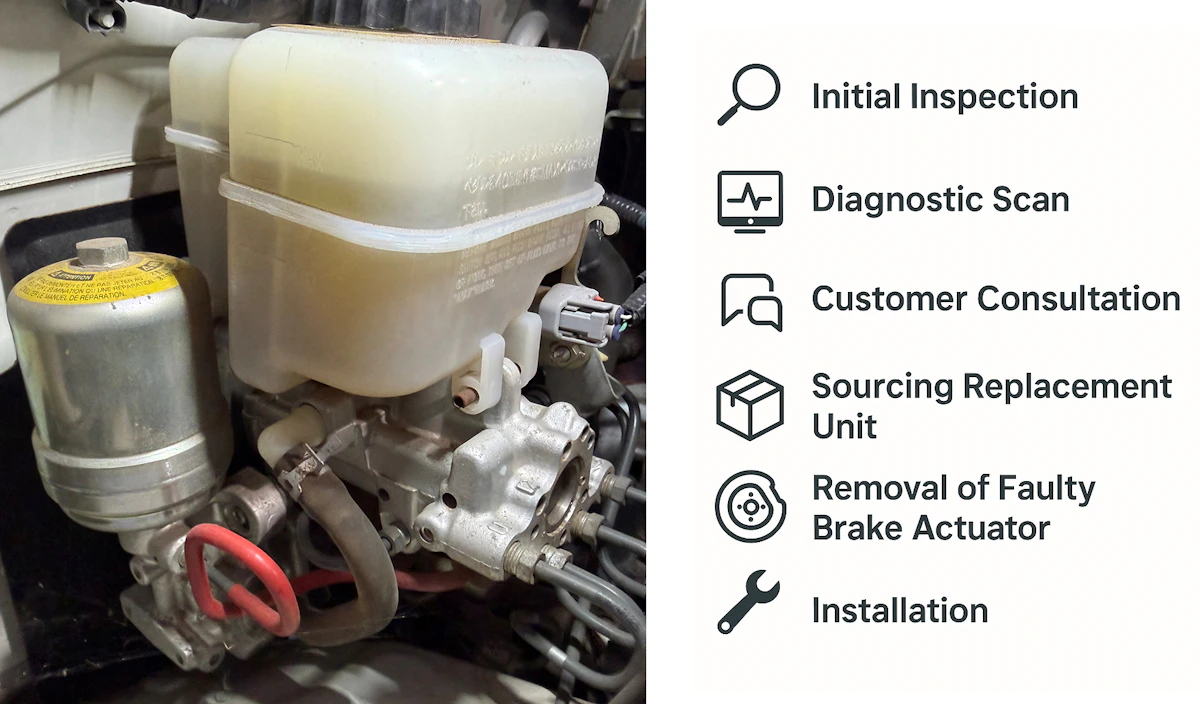
Step 1: Initial Inspection & Safety Check
The first step was to confirm the fault and ensure the vehicle was safe to work on. Our technicians:
- Carried out a visual inspection for brake fluid leaks, damaged lines or obvious mechanical failures
- Checked the brake fluid level and condition
- Verified that the pedal feel was abnormal and braking assistance was not operating
No external hydraulic leaks were found, pointing toward an internal or electronic fault rather than a traditional hydraulic failure.
Step 2: Diagnostic Scan & Fault Code Analysis
Using advanced diagnostic equipment, a full system scan was performed. Fault codes stored in the ABS and brake control module indicated an internal electrical failure within the brake actuator assembly.
Live data confirmed that the actuator motor and internal solenoids were not responding correctly, preventing proper brake pressure from being generated. At this point, the root cause was identified as an electrical failure inside the brake actuator unit.
Step 3: Customer Consultation & Cost Assessment
The customer was advised that a brand-new brake actuator from the manufacturer would be extremely expensive and would likely exceed their budget. This type of part can cost many thousands of dollars before labour is even considered.
To help keep costs under control, Beechboro Mechanical offered an alternative solution: sourcing a quality second-hand brake actuator assembly. The challenge was availability. This component is not commonly stocked locally and is difficult to find due to demand and limited supply.
Step 4: Sourcing a Replacement Unit
Our parts team contacted multiple suppliers across Australia and located a suitable second-hand brake actuator in South Australia. The part was inspected and verified for compatibility before purchase.
This approach allowed the repair to be completed for roughly the cost of a new part alone, rather than the much higher total cost of a new unit plus fitting.
Step 5: Removal of Faulty Brake Actuator
Once the replacement part arrived, the original faulty unit was removed. This process involved:
- Safely isolating the electrical system
- Depressurising the brake system
- Disconnecting brake lines and electrical connectors
- Removing the actuator assembly from the engine bay
Due to the complexity of the unit and its role in braking and stability systems, careful handling was essential.
Step 6: Installation & System Programming
The replacement brake actuator was installed and all hydraulic lines and electrical connectors were refitted. The system then required:
- Brake system bleeding using diagnostic equipment
- Electronic calibration of the actuator
- Clearing fault codes
- Functional testing of ABS, traction control and braking response
These steps are critical with modern electronic brake systems, as incorrect setup can result in further faults or unsafe operation.
Step 7: Road Test & Final Safety Checks
The Prado was road tested under controlled conditions. Braking performance was restored to normal, warning lights were eliminated and pedal feel returned to expected operation. A final inspection confirmed:
- No leaks
- No fault codes
- Correct brake pressure operation
- Stable braking under load
The Outcome
The Prado was successfully repaired and returned to the customer with fully functioning brakes. By using a carefully sourced second-hand part, the repair was completed for approximately the cost of a new actuator alone, rather than the significantly higher price of a full new replacement and labour.
This repair saved the customer thousands of dollars while maintaining safety and reliability.
Why This Matters
Modern braking systems are no longer purely mechanical. They rely heavily on electronics, sensors and control modules. Failures like this can appear suddenly and completely disable a vehicle. This case highlights the importance of:
- Accurate diagnostics
- Experience with modern brake systems
- Flexible repair options to suit customer budgets
- Access to hard-to-source components
At Beechboro Mechanical in Beechboro, our technicians are equipped with the tools and knowledge to diagnose complex braking faults and find practical solutions — even when parts are difficult to source…